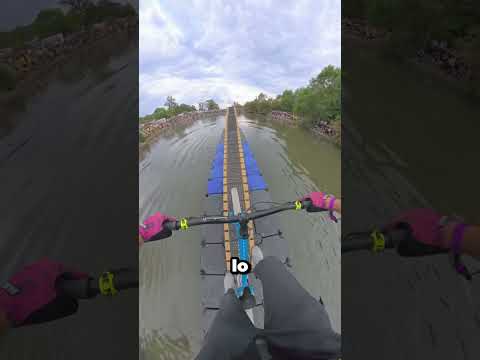
There are videos that turn something seemingly innocent into a nerve-wracking experience. A cyclist rides along a narrow floating path over the water; he pedals calmly, reaches a section that sways, and just when it looks as though a fall is inevitable, he regains control and completes the journey. The scene illustrates a rather unromantic truth: out on the water, even a small mistake makes a big difference.
Water bikes are based on a much gentler idea than that balancing challenge. They allow you to cycle on lakes, harbours, canals or protected coastal areas, using systems designed to float and remain stable. They don’t usually require the reflexes of a tightrope walker or the poise of someone having breakfast on a tightrope. But they do offer a different way of exercising and of looking at the sea: at water level, in relative silence and with your legs working.
What exactly is a water bike?
The term covers several inventions, and it’s worth clarifying this before you picture a city bike with a rusting frame two metres from the shore. A water bike, or hydro-bike, is a lightweight vessel propelled by pedals. The cyclist’s movement drives a propeller, a system of blades or a transmission that propels the craft through the water.
The pedalling position is mounted on a floating structure, usually comprising one or more hulls, pontoons or high-volume boards. In other, more sporty models, the cyclist is raised on hydrofoils: as speed increases, these submerged wings lift part of the structure above the surface and reduce drag. The sensation is closer to gliding than to cycling, although it requires technique, rhythm and the right conditions.
There are also hybrid designs that use a wide board, a modified exercise bike or shared platforms for two or more people. Here, the concept becomes less athletic and more social: a cycling outing, complete with conversation and the chance to discover that the friend who boasts about doing spinning actually has a complicated relationship with headwinds.
Stability, propulsion and balance: not all are ridden in the same way
The main difference between the various types lies in their stability. Bikes with two side floats are usually the most intuitive for beginners. They offer a wide base, a familiar riding position and a leisurely ride; they are suitable for gentle trips and sheltered waters.
Hydrofoil bikes, on the other hand, are designed for performance and a more technical experience. To make them work well, you need to maintain a steady cadence, control the direction and learn to manage changes in pace. They’re not impossible, but it’s not a good idea to try them out on a choppy day with the same confidence as when you order a croquette ‘just to try it’.
The video in question takes balance to the extreme: a narrow, shifting course punishes any deviation. On a recreational water bike, it’s not a question of surviving a wobbly walkway, but the principle is similar. Keeping your eyes forward, making smooth movements and pedalling at a steady pace help more than sudden corrections. Anyone who tries to wrestle with the handlebars as if they were taming a mechanical bull is likely to end up learning a very wet lesson.
Tips for your first ride
- Start in calm waters: harbours, authorised canals, lakes or sheltered bays allow you to get to grips with steering and pedalling.
- Check your kit: life jacket, steering system, boarding points and the operator’s or local regulations.
- Avoid rushing: getting on and off slowly is part of the manoeuvre, not a formality to be skipped with Olympic enthusiasm.
- Check the weather forecast: wind, waves and currents can completely alter the difficulty and enjoyment of the experience.
- Respect maritime traffic: a pedal-powered craft does not have the reaction time of a motorboat, nor should you pretend it does.
A leg workout with a seaside backdrop
Pedalling on the water transforms the familiar motion of cycling into a low-impact endurance exercise. The legs take centre stage, whilst the torso helps to stabilise the body and support the pedalling motion. The intensity depends on the design of the boat, the pace, the distance and, of course, the water conditions.
For many people, the appeal lies not in breaking records but in maintaining physical activity without the repetitive strain of running on tarmac. The sea adds an incentive that is hard to replicate in a gym: a breeze, changing light and a different perspective of the coast. Although it’s best not to idealise it too much. With a headwind, nature also knows how to throw in high-intensity intervals without warning.
The activity can suit adults looking for an active yet moderate experience, couples, groups of friends and families, provided the model, minimum age and safety conditions allow it. The more stable versions are usually the most accessible; the sportier ones require greater agility and a reasonable level of fitness.
Pedalos versus stand-up paddleboarding, kayaking and jet skis
The Barcelona coastline and the Mediterranean offer a rather impressive range of water sports. The choice depends less on which is ‘best’ and more on what sort of day you fancy having.
- Compared to stand-up paddleboarding: the pedal boat reduces the need to maintain your balance whilst standing and frees your hands from the paddle. Stand-up paddleboarding, on the other hand, offers a more direct connection with the water and is easier to transport when using an inflatable board.
- Compared to kayaking: kayaking allows you to paddle whilst seated, manoeuvre with precision and access coves or nooks where pedalling might not be so practical. The water bike offers a more upright position and a familiar motion for those who cycle regularly.
- Compared to a jet ski: here, the scenario changes completely. The jet ski is associated with speed, power and adrenaline; the water bike is all about setting your own pace, taking in your surroundings and making far less noise. One does not replace the other: they are activities for radically different moods.
There’s room for them all. One morning you might fancy a leisurely cycle; another, a kayaking trip along the coast; and yet another, a jet-ski ride with your heart rate working overtime. The sea doesn’t force you to choose sides.
Where do they fit in Barcelona and along the Mediterranean coast?
By their very nature, water bikes are best suited to areas with relatively sheltered waters and organised facilities: marinas, lagoons, reservoirs, lakes or calm stretches of coastline where the activity is permitted. On the open coast, the waves, wind and boat traffic demand greater caution and can make an activity that, on paper, seemed like a leisurely ride, rather inadvisable.
In Barcelona, before setting off on an impromptu route off the beach, it’s important to check local regulations, authorised navigation zones and whether there are any companies offering equipment, guides or hire services. Port and coastal regulations aren’t just there to decorate a noticeboard: they govern the coexistence of swimmers, boats, water sports and emergency services.
The appeal of these machines lies precisely in their practical uniqueness. They do not promise the wild speed of a jet ski nor the minimalist simplicity of a surfboard. They offer something else: propelling yourself forward using your legs, on a surface that normally forces us to swim, paddle or start an engine. And that slight contradiction — pedalling out to sea without sinking — has something delightfully absurd about it. Like almost all good aquatic adventures.