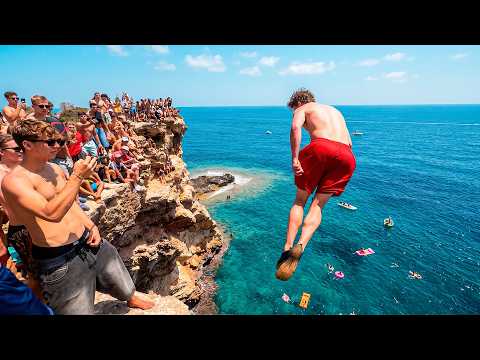
There are sports that are best appreciated from the shore, with dry feet and a safe emotional distance. Cliff diving – acrobatic jumps from platforms or cliffs into the water – falls into this category: a blend of technique, vertigo and pinpoint precision in which a mistake cannot be put right with a simple ‘oh well, there’s always next time’.
Mallorca, with its jagged coastline and sheer rock faces rising from intensely blue waters, provides the perfect natural backdrop for this spectacle. The video of the Mallorca Cliff Tour showcases precisely this competitive side: eight specialists, two rounds of dives and a height measured on site at 24.30 metres. A Mediterranean postcard, yes; but also an extreme discipline that demands infrastructure and preparation far removed from an impromptu holiday dive.
What turns a cliff dive into a competition
In a top-level event, it is not enough simply to reach the top, look down and overcome your survival instinct — which, incidentally, usually has quite reasonable grounds. The participants perform somersaults and rotations before entering the water, and the score takes into account both the difficulty and the control of the execution.
The competition held in Mallorca consisted of two rounds: the result was calculated as the average of both dives. It’s an interesting format because it prevents a single moment of brilliance from masking an otherwise inconsistent performance. It rewards the all-round athlete, capable of maintaining precision, orientation and nerves of steel twice in a row.
The height adds a daunting dimension to the whole thing. From above, the sea may look like a gigantic, gentle swimming pool; during the fall, the body quickly gains speed and the water ceases to be that soft surface one associates with an afternoon at the beach. The entry must be very clean, and there is minimal scope for correcting a misjudged turn. That is why divers train for years and why new manoeuvres are introduced with the utmost caution.
Mallorca: a natural setting, not an invitation to imitate it
The Mediterranean has coves, caves and cliffs that look as though they were designed by a cinematographer with an unlimited budget. Mallorca stands out in particular for this combination of rock, crystal-clear waters and steep slopes. But the landscape does not guarantee the safety of a dive. Just because a spot looks good on camera does not mean it is suitable for diving.
The event featured in the video shows a specific organisational structure: an area for athletes, a control point to ensure the water is clear before attempts, support staff and an ambulance on site throughout the day. The height of the take-off point is also measured. These aren’t just window dressing to make the event look serious; they’re part of the fundamental difference between a competition and a reckless stunt in swimming trunks.
The day also reveals the less glamorous side of things. A dive can go wrong even in experienced hands, and the immediate reaction of the support team is crucial. Professional cliff diving does not deny the risk: it acknowledges it, studies it and tries to minimise it through protocols. Adrenaline without protocol is just a bad idea with good lighting.
Professional and recreational: the line that should not be crossed
Recreational high-altitude diving has become very visible on social media, where we often see only the three seconds of flight and never the pre-dive checks, the diver’s experience or, worse still, the consequences of a bad decision. It is important to draw a thick, fluorescent line between the two worlds – one that is hard to ignore.
What lies behind a professional jump
- Technical training: body control, spatial awareness, water entries and progression in depth.
- Site reconnaissance: depth, submerged obstacles, entry point and changing water conditions.
- Surface support: monitoring of the area, boats or rescue personnel depending on the setup, and available medical care.
- Controlled conditions: do not dive if the environment does not allow it to be done with reasonable safety.
Anyone lacking this preparation should not attempt to perform tricks or high dives. Nor should they assume that knowing a cove is the same as knowing its seabed today: swells, currents, boats, tidal changes, hidden rocks or insufficient depth can turn a seemingly simple manoeuvre into an emergency.
The most useful rule is also the least dramatic: if it is not an area that has been specifically designated, inspected and supervised, do not jump. You must never do so whilst under the influence of alcohol or drugs, alone, from an unfamiliar spot, or when there are waves, poor visibility or boat traffic. And, of course, no one should dive just to win a silly argument. The Mediterranean has already seen enough decisions inspired by a ‘dare’.
How to enjoy a cliff diving competition
As a spectator, cliff diving has a hypnotic quality: the brief silence before the jump, the countdown, the sharp thud of the splash and the collective sigh of relief when the athlete resurfaces. If you’re attending an event, it’s sensible to stay within the designated areas and follow staff instructions. It’s particularly important not to swim near the landing zone or approach it on surfboards, jet skis or boats in an attempt to get ‘the shot’. A good story isn’t made any better if it ends up getting in the way of a diver.
It’s also worth looking beyond the flight itself. The preparation, the concentration before taking the platform, and the consistency between rounds count just as much as the final stunt. It’s a sport where aesthetics depend on almost surgical discipline, even though from the outside it might look as though someone has decided to negotiate with gravity without a lawyer present.
Mediterranean adrenaline with a more welcoming entry point
For those who want the sea, speed and a good burst of energy without putting their relationship with heights of 24 metres to the test, the Catalan coast offers far more accessible options. In Barcelona and elsewhere along the Mediterranean coast, jet-ski excursions allow you to explore the coastline under the supervision and guidance of authorised operators. They are no substitute for a cliff jump; fortunately, they don’t require you to learn how to fall off one either.
Parasailing offers a different kind of perspective: height, a gentle breeze and a sweeping view of the coast, provided the sea conditions and the operator allow it. Flyboarding, meanwhile, combines balance and propulsion on the water during guided sessions, with a learning curve that usually includes the odd, far from heroic – and entirely normal – splash.
The key is to choose activities suited to your own experience, listen to the safety briefing and accept that cancellation due to wind or rough seas is a sign of professionalism, not a spoilsport. Competitive cliff diving inspires with its daring; the rest of us can take away the smarter part of the lesson: enjoying the sea to the full without causing extra work for the rescue teams.